Satterberg Foundation Advances Wing Luke’s Legacy
The important work of ending inequality is a team sport. The Wing Luke Museum has served the community and delivered its mission in large part because of a powerful partnership that exists among staff, Trustees, artists, members, donors, and importantly, Foundations. Individually, and collectively, each plays a role in carrying the Museum’s work forward.
One such foundation is The Satterberg Foundation, a 35-year-old entity that promotes justice and equity through grants, providing approximately $40 million each year to numerous organizations. For six years, this family foundation has been a crucial partner to the Museum, helping to power its work, and advancing Wing Chong Luke’s legacy. As the Museum recognizes Wing Luke’s 100th birthday, it is fitting to acknowledge the role that the Foundation has played.
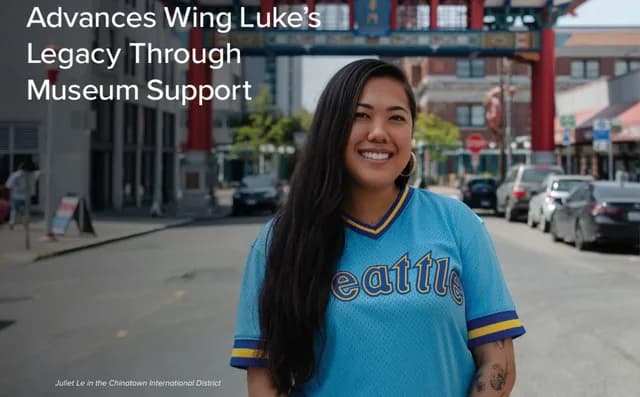
Wing Luke fought discriminatory practices that were prevalent in 1960s Seattle and advocated for cultural preservation. Juliet Le, Satterberg Foundation’s Program Officer for the past six years, believes that it is important, more so today, to “abundantly resource” cultural institutions like the Museum that promote equity for the long term because, even though Wing Luke did make strides for racial equity, there is still so much work to do still.
“I think Wing Luke’s legacy serves as a powerful reminder of the importance of reclaiming and honoring our histories, particularly for Asian American and Pacific Islander communities, who have long been marginalized,” says Le. “I think his milestone birthday also reminds us to ensure his vision for cultural empowerment, social justice and community resilience continues to thrive, despite the times we are in.”
Le’s connection to the Museum and the Chinatown International District (C-ID) dates back to her childhood, when family trips to Seattle were treated like a family vacation. Today, the neighborhood has changed from the days of her youth. The place of her youth has diminished, which is not lost on her.
“It feels like our histories are being erased piece by piece,” she says. “I think the C-ID is not just a neighborhood, it is a living testament to community strength, cultural survival and the vital act of remembering…the Museum plays an essential role in preserving these stories, creating spaces for healing and reclaiming.”
She considers her work at the foundation as a step toward helping to preserve the community’s culture, traditions and history, to safeguard that history and empower communities that call the neighborhood home.
On a team of nine people, Le manages a grantee portfolio of organizations that work at the intersections of social and environmental justice, across a three-state area, including Washington state.
“I would say that one of the most gratifying parts of the work is being able to return resources to communities that have been marginalized and excluded from mainstream narratives,” she says, later adding, “So I think supporting nonprofit arts, heritage and culture organizations is a chance to repair some of the damage done by colonization and systematic racism, and ensuring that communities can tell their own stories.”
As a long-time partner, the foundation was acutely aware of the challenges facing the Museum this past year related to the Confronting Hate Together exhibit. The organization did not hesitate in its belief in the Museum and remained unwavering in its support and allyship.
“If a nonprofit is going through something really hard, we’re like ‘How can we show up?’” she says. “What do we need to do to support you right now? Our perspective on resourcing (the Museum) is that the money doesn’t belong to us…it needs to be returned to the community. We’re just stewards of those resources.”
As Le reflects upon Wing Luke’s 100th birthday as a backdrop to the foundation’s years of investment in the Museum, she believes Wing Luke would express deep appreciation – not just for the support itself, but for how it’s been offered.
“Long-term, sustained, unrestricted funding is still far too rare in philanthropy,” she says, noting, “In that spirit, our support of the Wing Luke Museum has been about walking alongside, not directing from above. I think Wing Luke, given his lifelong commitment to equity, anti-discrimination and making sure every voice has a seat at the table, would see that as an extension of his values.”

Key Highlights
- Six-year partnership between Satterberg Foundation and Wing Luke Museum
- Featured in the museum’s 2024 Report to the Community honoring Wing Luke’s 100th birthday
- Managed grantee portfolio at intersections of social and environmental justice across three states
- Championed long-term, sustained, unrestricted funding as trust-based philanthropic practice
- Supported the museum through the Confronting Hate Together exhibit challenges